

CPI and Fed Expectations Shake the Market as U.S. Stocks Trade in a Narrow Range and Chinese Stocks Come Under Pressure
Keywords: U.S. stock trend, CPI data, Fed expectations, Chinese stocks, Nasdaq Golden Dragon China Index, market sentiment
Introduction
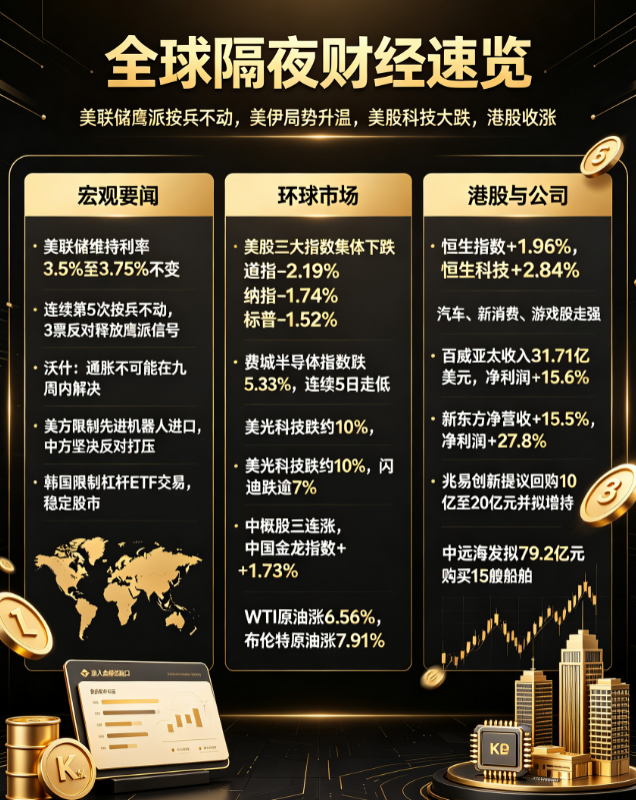
On Thursday local time, U.S. stocks traded in a tight range in the absence of major economic data or a strong catalyst. On the one hand, the market continued digesting the inflation signal from the latest CPI report; on the other, it was weighing how the Federal Reserve's next comments could affect the rate path. In the end, the three major indexes finished mixed, with clear divergence and a cautious tone. Notably, popular Chinese stocks weakened across the board, and the Nasdaq Golden Dragon China Index fell 3.09%, making it one of the more notable global pullbacks of the day.
Market performance: cautious trading under narrow-range moves
Looking at the tape, U.S. stocks did not show a clear one-way trend on Thursday mainly because there was no new catalyst. After the CPI release, investors had already repriced the balance between cooling inflation and staying-high rates, while recent Fed comments have made it hard for rate-cut expectations to rebound quickly. In this setting, capital preferred to wait for the next batch of important data before taking a stronger view on the economy and policy.
Mixed index performance shows that no single consensus had formed inside the market. Some investors believe inflation pressure is easing and there is limited room for rates to rise further; others worry that core prices remain sticky and the rate-cut window may be pushed back again. As a result, buying and selling pressure offset each other, keeping index moves small but sector rotation active.
Chinese stocks fall broadly: pressure from sentiment and valuation
Compared with the calm in the broader U.S. market, Chinese stocks were weaker. The Nasdaq Golden Dragon China Index fell 3.09% on the day, and popular Chinese ADRs declined broadly, reflecting a drop in overseas investors' risk appetite for the group. Pressure on Chinese stocks is often linked not only to company fundamentals, but also to the external environment, liquidity expectations and the U.S.-China rate spread.
On one hand, if U.S. rates stay high for longer, the appeal of dollar assets rises temporarily and growth valuations get compressed. On the other hand, Chinese stocks also face earnings delivery, industry competition and regulatory expectations. When sentiment weakens, capital often leaves high-beta, high-volatility sectors first, which is one reason Chinese stocks tend to fall more than the broader market.
Outlook: watch inflation and policy as the two main threads
Looking ahead, the market focus will still revolve around inflation data and Fed policy expectations. If upcoming data shows inflation cooling further and the labor market does not deteriorate sharply, confidence in rate cuts later this year could recover and risk assets may regain support. Conversely, if price stickiness persists and core inflation slows only gradually, the Fed may stay hawkish longer than the market expects, leaving equities — especially growth names — under valuation pressure.
For investors, this stage calls for a greater focus on portfolio resilience rather than short-term emotion trading. The broader U.S. market may still be relatively strong, but faster internal rotation and deeper divergence mean execution is getting harder. In Chinese stocks, without fundamental improvement or policy catalysts, near-term rebound potential may still be limited by external liquidity and risk appetite.
Conclusion
Overall, Thursday's narrow U.S. stock moves reflect a cautious balance between CPI data and Fed expectations, while the sharp pullback in Chinese stocks shows that overseas capital has become more conservative toward high-valuation growth assets. Over the next period, the market direction will still be driven by macro data, and investors should watch inflation, rates and earnings closely. Until uncertainty fades, patience and caution may be more important than chasing short-term swings.