

Memory Price Surge Triggers Antitrust Lawsuit Against Samsung, SK Hynix, and Micron
Keywords: DRAM, HBM, memory prices, antitrust lawsuit, Samsung, SK Hynix, Micron, supply constraints, consumer electronics, class action, price manipulation
Introduction
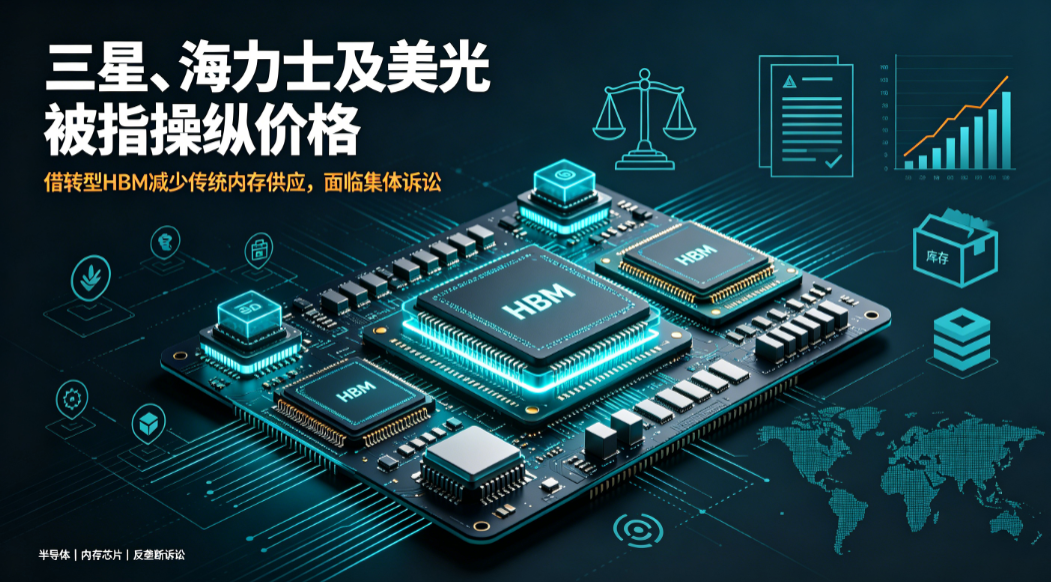
The global memory market, once driven by cyclical booms and busts, is now facing a more serious challenge: tight supply and rapidly rising prices have put major chipmakers at the center of a U.S. antitrust case. Samsung, SK Hynix, and Micron — the three dominant DRAM producers — are accused of coordinating output cuts and pricing behavior that allegedly pushed memory prices up by about 700% over the past four years.
Filed in federal court in California by 14 consumers and three small businesses, including a PC retailer, the case has drawn broad attention because it goes beyond a routine pricing dispute. It raises deeper questions about market power, industrial strategy, and whether a highly concentrated memory industry has crossed the line from competition into coordinated conduct.
The Lawsuit and Its Core Allegations
According to the complaint filed on June 25, the plaintiffs say the three companies began coordinating supply and prices as early as 2022. The case is before the U.S. District Court for the Northern District of California, with Judge Noel Wise presiding. The plaintiffs are represented by Bathaee Dunne LLP, a firm that has handled major antitrust cases, including a successful suit involving Google's digital advertising practices.
At the center of the complaint is the claim that the defendants used the transition to high-bandwidth memory, or HBM, as a pretext to reduce production of legacy DRAM products such as DDR3 and DDR4. The plaintiffs argue that this was not simply a natural market shift, but part of a broader strategy to restrict supply in consumer memory while preserving pricing power across the industry.
The complaint also alleges that the companies ignored "all economic and business logic" by cutting output of consumer-facing DRAM during what should have been a highly profitable period. One example cited is Micron's plan to shut down its consumer-oriented Crucial DRAM business in 2025, despite what the plaintiffs describe as one of the business's most profitable periods ever.
Why This Case Matters: Market Concentration and Barriers to Entry
The significance of this lawsuit extends beyond the parties involved. The DRAM market is highly concentrated, and the barriers to entry are enormous. Building a new DRAM fabrication facility reportedly requires $15 billion to $20 billion, plus a long development and qualification process. In other words, new entrants cannot quickly restore competition or discipline prices.
This structure gives incumbent leaders substantial influence over output and inventory. In a competitive market, higher prices would normally attract new supply. In DRAM, however, capital intensity, technical complexity, and long lead times weaken that adjustment mechanism. As a result, when the biggest players tighten supply, the effects can last for years rather than months.
The plaintiffs say that is exactly what has happened: supply discipline has not been a temporary response to weak demand, but a prolonged strategy that helped keep memory prices elevated even after earlier cyclical shocks faded.
The HBM Transition: Industrial Strategy or Supply Restriction?
One of the most important parts of the case is the role of HBM. High-bandwidth memory is in strong demand because it is used in AI hardware, advanced computing, and high-performance GPUs. In many ways, the shift from older DRAM generations to HBM reflects a rational move toward more profitable, faster-growing segments.
However, the lawsuit suggests the transition may have been used as a convenient excuse to shrink supply in the mainstream DRAM market. If true, that would mean a legitimate technology upgrade was paired with a deliberate reduction in DDR3 and DDR4 availability, worsening shortages in the consumer market.
That distinction matters. Companies are generally free to reallocate production toward higher-value products. But if that reallocation is used to coordinate prices or suppress competition, it can become an antitrust issue. The court will therefore need to decide whether the defendants acted independently or as part of a concerted effort to manipulate the market.
Evidence of Downstream Impact
To support their claims, the plaintiffs point to price effects across consumer electronics. Apple's recent price increases for certain iPad and Mac products are cited as evidence that memory shortages are affecting final product costs, not just component prices.
This is an important economic argument. DRAM is a core input in a wide range of devices, from PCs and laptops to tablets, servers, and consumer electronics. When memory prices rise sharply, the impact does not stay at the chip level. It moves through the supply chain, pressuring manufacturers, retailers, and ultimately consumers.
That is especially relevant now, as many device makers are already dealing with tariffs, weaker demand in some categories, and rising costs in other components. Memory inflation adds another layer of pressure, making it harder for downstream companies to absorb costs without passing them on.
A Familiar Legal and Historical Backdrop
The lawsuit also recalls earlier antitrust cases in the memory industry. Korean media reports note that Samsung Electronics and SK Hynix have previously faced U.S. findings of collusion in DRAM pricing. Samsung, for example, was fined $300 million by the U.S. Department of Justice in 2005 for DRAM price manipulation between 1999 and 2002. Several PC makers, including Dell, Compaq, HP, Apple, IBM, and Gateway, were affected by that earlier conduct.
This history does not decide the outcome of the current case, but it does increase scrutiny. When an industry has a documented history of cartel-like behavior, courts and regulators may be more willing to examine whether similar patterns have returned under new market conditions.
At the same time, the defendants will likely argue that today's pricing reflects genuine supply-demand imbalance, not collusion. The rise of AI workloads, the shift toward higher-performance memory, and wafer capacity constraints all provide legitimate explanations for a tight market. The court's challenge will be separating structural realities from unlawful coordination.
What the Case Means for Consumers and Businesses
For consumers, the near-term outlook remains unfavorable regardless of the lawsuit's eventual outcome. Memory prices are already high, and industry forecasts suggest the trend may continue for several more years.
Jefferies has projected that memory prices could rise another 40% to 50% quarter over quarter in the third quarter of 2026, followed by an additional 30% to 40% increase in the fourth quarter. It also expects prices in 2027 to remain 40% to 45% higher year over year, with meaningful relief unlikely before 2028 at the earliest.
If that forecast proves right, the memory cost shock will not be short-lived. It will affect PC upgrades, enterprise procurement, data center expansion, and consumer device pricing over a long period. For small businesses and retailers, especially those with thin margins, this environment could be particularly damaging.
Conclusion
The antitrust lawsuit against Samsung, SK Hynix, and Micron is about more than memory pricing. It is a test of how the law should respond when a small number of dominant suppliers control a critical technology market undergoing rapid change. On one side is the argument that the companies are simply adapting to the rise of HBM and next-generation computing. On the other is the allegation that they used that transition to restrict supply, sustain artificially high prices, and extract outsized profits from consumers and downstream businesses.
Whether the plaintiffs can prove collusion remains to be seen. But the broader issue is already clear: in a market as concentrated and strategically important as DRAM, supply decisions can shape not only corporate earnings, but also the cost structure of the entire digital economy. Even if the courts do not intervene immediately, elevated memory prices are likely to remain a major pressure point for consumers and technology companies for years to come.