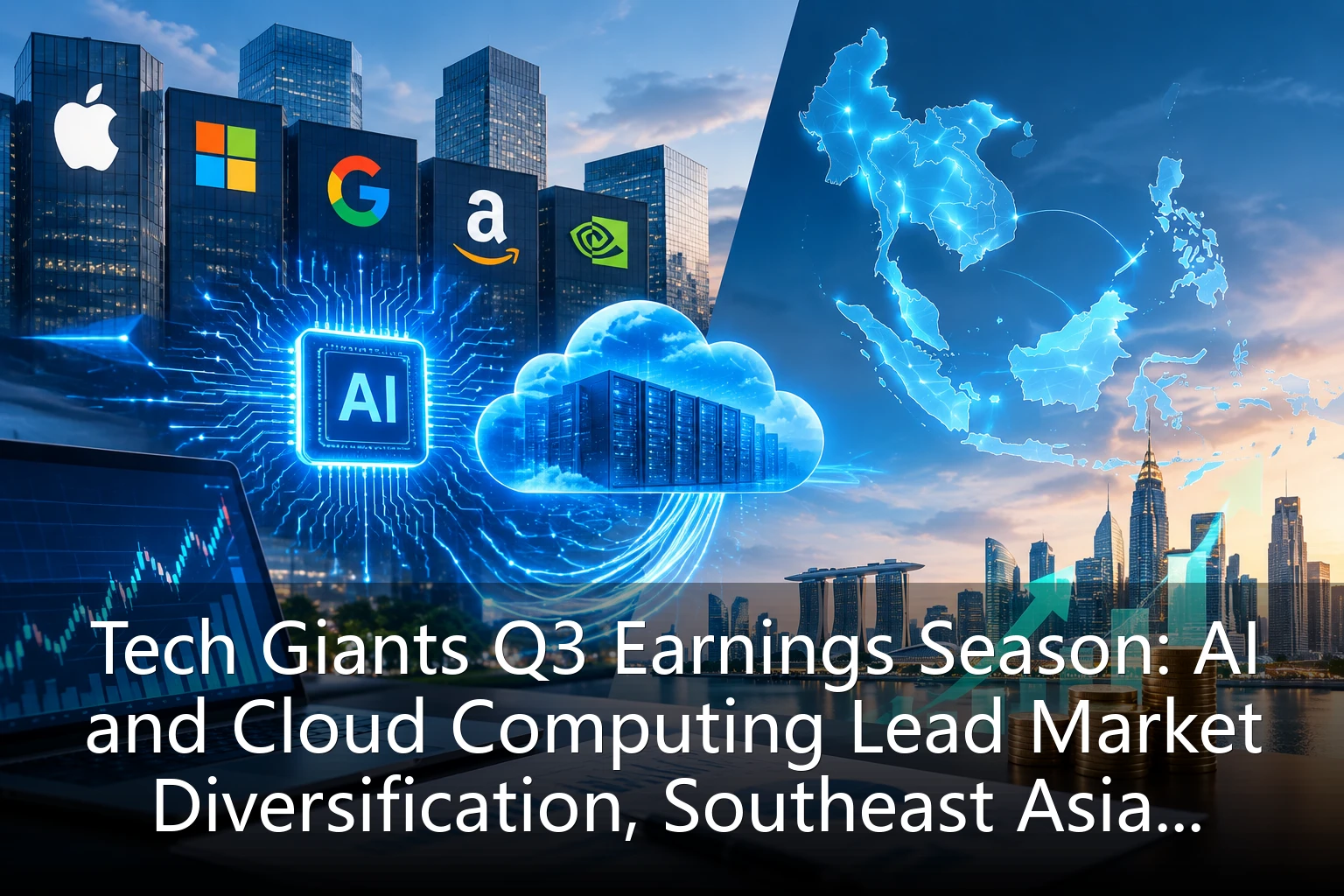



Tech Giants' Earnings Season Leading US Market Trends
The second quarter earnings season of 2026 is in full swing, with performances of tech giants not only affecting individual stock movements but also having profound impacts on the entire US stock market. The competition between Microsoft and Google's parent company Alphabet in the artificial intelligence field has intensified, with financial reports from both companies becoming the focus of global investors. This quarter's tech stock performance not only reflects companies' innovation capabilities but also indicates the future development direction of the global tech industry.
AI Competition Accelerates, Tech Giants' Performance Diverges
Microsoft's latest earnings report shows its Azure cloud service revenue increased by 35% year-over-year, with AI-related businesses contributing to over 20% of that growth. CEO Satya Nadella emphasized in the earnings conference, "AI has become the core driver of Microsoft's business growth, and we are fully integrating AI capabilities into our product matrix, from Office to Windows, from Teams to Xbox." This statement further solidified Microsoft's leading position in the AI field.
In contrast, Alphabet's performance presents a more complex situation. Although Google's search business remains stable, its cloud business growth slowed to 28%, below the market expectation of 30%. CEO Sundar Pichai admitted in the earnings conference call, "Cloud computing market competition is intensifying, and we need to accelerate AI innovation to maintain competitiveness." This statement raised concerns in the market about whether Google can maintain its leading position in the AI field.
Notably, Apple performed impressively in this quarter's earnings, with iPhone sales exceeding expectations, particularly strong performance in Asian markets offsetting some weakness in European markets. CEO Tim Cook stated, "We are upgrading existing product lines with AI features while advancing innovative projects like Vision Pro, laying a solid foundation for future growth." Apple's stable performance has made it a safe haven choice in tech stocks.
Southeast Asian Capital Investing in Tech Stocks Through ETFs
Facing divergent performances from tech giants' earnings reports, Southeast Asian investors are reallocating tech stock positions through cross-border ETFs. Singapore Exchange data shows that in the first half of 2026, net inflows into ETFs tracking US tech stocks reached a record $12 billion, with over 40% coming from institutional investors in Southeast Asia.
Chen Ming, investment director at Alpha Capital, a Singaporean wealth management company, stated: "Southeast Asian investors are adopting a 'core-satellite' strategy, using tech ETFs as core allocations while selecting individual stocks as satellite positions. Stable tech stocks like Microsoft and Apple are favored, while AI concept stocks are positioned as high-risk, high-return investments." This strategy reflects investors' cautious yet optimistic attitude amid tech stock divergence.
Li Hua, a strategy analyst at SCB Asset Management in Thailand, pointed out: "The allocation logic for Southeast Asian investors regarding US tech stocks has shifted from 'growth narrative' to 'profit verification.' As AI technology moves from concept to practical application, investors are paying more attention to whether tech giants' AI businesses can truly translate into revenue and profits." This trend is reshaping Southeast Asian capital's investment logic regarding US tech stocks.
The Subtle Relationship Between Fed Policy and Tech Stocks
Despite strong tech stock performance, Fed policy remains a significant factor affecting the market. The market widely expects the Fed to cut interest rates in September, providing a favorable environment for tech stocks. Historical data shows that in the early stages of a rate-cutting cycle, growth-oriented tech stocks often outperform value stocks.
However, analysts warn that if inflation data continues to exceed expectations, the Fed may delay its rate-cutting timeline, which could put pressure on high-valued tech stocks. Wang Qing, chief Asia economist at Morgan Stanley, stated: "Tech stocks are highly sensitive to interest rate environments. With increasing inflation uncertainty, investors need to pay closer attention to tech giants' cash flow and profitability."
Notably, some tech giants have begun adjusting capital expenditure strategies. Microsoft announced a 20% increase in AI-related capital expenditures, while Google indicated it would maintain a cautious spending pace. This divergence reflects different expectations for AI investment returns and suggests the tech industry may enter a new stage focused on efficiency.
Industrial Landscape Reshaping Behind the AI Competition
The competition among tech giants in the AI field is reshaping the entire industrial landscape. Through deep cooperation with OpenAI, Microsoft has established a first-mover advantage in generative AI applications, with its Copilot series gaining high recognition from enterprise users. Meanwhile, Google is striving to catch up through PaLM 2 models and Gemini systems, trying to narrow the gap with Microsoft in AI infrastructure and applications.
This competition is reflected not only at the product level but also in talent recruitment and patent layout. According to Bloomberg, in the first half of 2026, patent applications in AI-related fields by tech giants increased by 60% year-over-year, with Microsoft and Google accounting for the majority. Meanwhile, both companies are actively recruiting AI research talent, causing AI talent salaries to continue rising.
Industry analysts point out that the AI competition is shifting from pure model performance comparison to ecosystem construction. Microsoft is building a massive AI application ecosystem by fully integrating AI capabilities into product lines like Office 365; while Google is relying on its search and Android ecosystems to achieve breakthroughs in AI applications. This ecosystem competition will determine the future market position of tech giants.
Tech Stock Investment Strategy: Balancing Value and Growth
Facing divergent performances in tech giants' earnings season, investors need to re-examine tech stock investment strategies. Zhang Wei, head of tech stock research at Singaporean investment bank DBS, advises: "Investors should adopt a 'core-satellite' strategy, using stable tech stocks like Apple and Microsoft as core allocations while selecting AI concept stocks as satellite positions. This strategy can capture growth opportunities from the AI revolution while controlling risks."
Data from the Hong Kong Investment Funds Association shows that in the second quarter of 2026, value-oriented tech stocks accounted for 55% of Southeast Asian capital's allocation to US tech stocks, exceeding growth-oriented tech stocks for the first time. This shift reflects investors' more rational attitude toward tech stock valuations and suggests tech stock investment may enter a new phase of value return.
For long-term investors, the tech giants' earnings season provides an opportunity to reassess investment portfolios. Lin Meiling, a strategy analyst at Malaysian investment company AmInvestment Bank, states: "The fundamentals of tech giants are undergoing structural changes, with increasing AI business proportion changing companies' profit models. Investors need to focus on the impact of these changes on long-term value rather than just short-term stock price fluctuations."
Conclusion: A New Investment Paradigm in the AI Era
The 2026 tech giants' earnings season reveals the accelerating trend of AI competition, with performances from companies like Microsoft and Google reshaping the US market landscape. For Southeast Asian investors, this period presents both challenges and opportunities. By investing in tech stocks through ETFs, investors can share the growth dividends from the AI revolution while controlling risks.
Looking ahead, as AI technology moves from concept to practical application, the competition among tech giants will shift from pure model performance comparison to ecosystem construction and application scenario expansion. In this context, investors need to focus more on whether tech giants' AI businesses can truly translate into revenue and profits, rather than just the popularity of AI concepts.
Fed policy direction, inflation data, and geopolitical risks will remain important factors affecting tech stocks. In the current environment, adopting a balanced investment strategy that pays attention to both tech giants' fundamental changes and macro factors will be key for investors to navigate tech stock volatility.
As the AI era deepens, tech stock investment is shifting from simple growth narratives to more complex value assessments. For Southeast Asian investors, understanding tech giants' strategic positioning and competitive advantages in the AI era will be crucial for seizing US stock market opportunities.