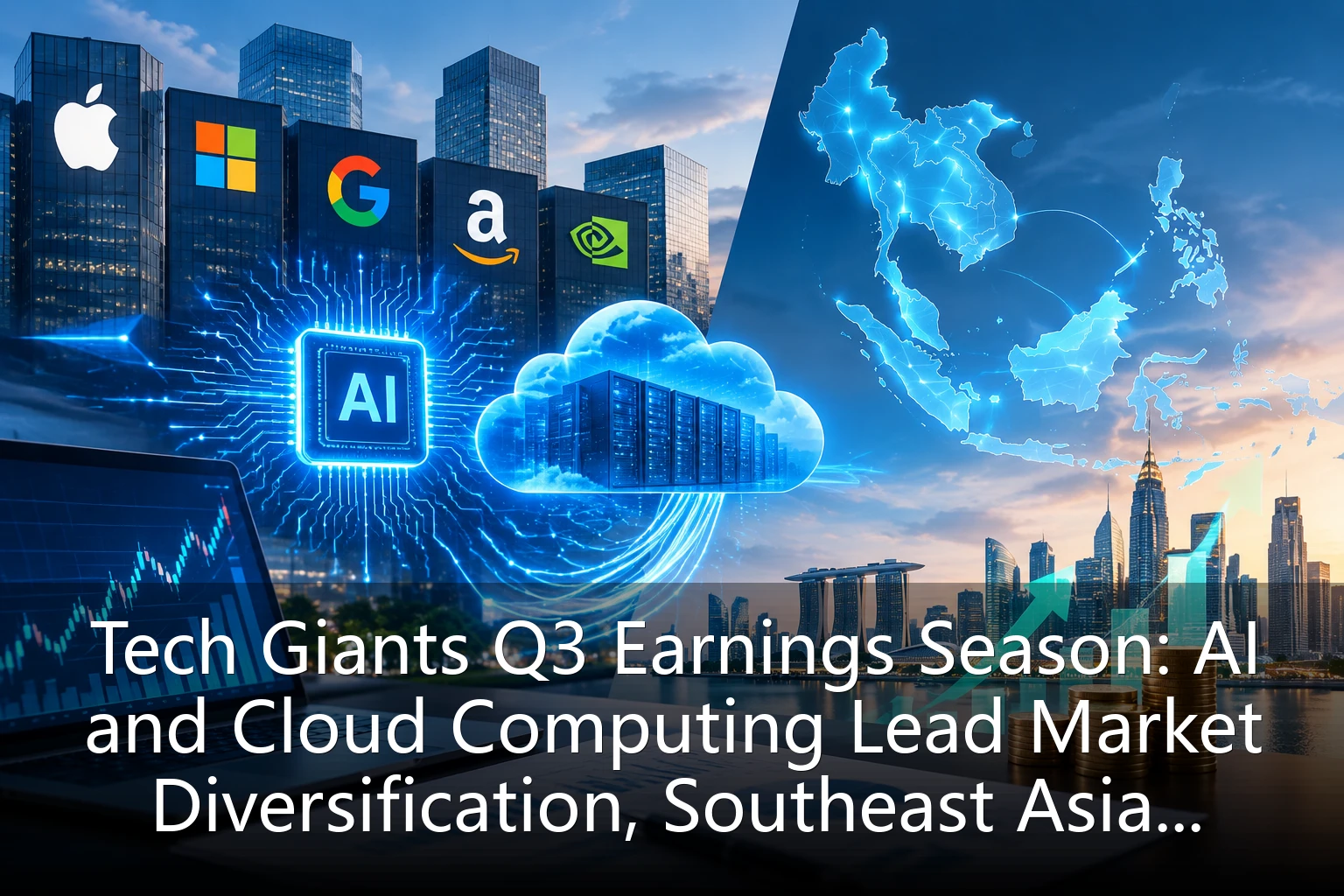


October 2026 saw the US stock market exhibit a clear divergence pattern, with accelerated rotation within tech giant sectors, and AI and cloud computing emerging as the primary forces driving the market. For Southeast Asian investors, capturing this rotation rhythm has become key to achieving excess returns. This article will conduct an in-depth analysis of the current market performance of tech giants, explore the rotation logic of AI and cloud computing sectors, and provide practical allocation strategies for Southeast Asian investors.
Market Performance of Tech Giants in October
Since entering October, US tech giants have shown a clear divergence in performance. Traditional tech giants represented by FAANG (Facebook, Amazon, Apple, Netflix, Google) have performed relatively steadily, while emerging tech stocks with AI and cloud computing as their core businesses have demonstrated strong growth momentum.
According to the latest data, the Nasdaq Technology Index rose by 3.2% in the first five trading days of October, outperforming the S&P 500 Index's 2.1% and the Dow Jones Industrial Average's 1.5%. This divergence trend indicates that the market is shifting more attention toward innovative tech companies with growth potential.
Particularly noteworthy is the outstanding performance of AI concept stocks in early October. AI hardware and software providers such as NVIDIA, AMD, and Microsoft have reached recent highs in stock prices, reflecting market optimism about the prospects of corporate AI businesses. Meanwhile, the cloud computing sector has also shown strong resilience. Despite increased market volatility, stock prices of major cloud service providers like Amazon AWS, Microsoft Azure, and Google Cloud have maintained steady growth.
Rotation Logic of AI and Cloud Computing Sectors
AI Industry Enters an Explosive Growth Phase
In 2026, the AI industry officially entered a period of explosive commercial application. According to the latest industry reports, the global AI market size is expected to reach $1.3 trillion in 2026, with a compound annual growth rate exceeding 35%. This growth is primarily driven by three major segments: enterprise AI solutions, AI chips, and AI infrastructure.
In the enterprise AI solutions sector, major tech companies have successively launched AI applications for vertical industries, covering finance, healthcare, manufacturing, retail, and more. These applications not only improve operational efficiency but also create new business models and revenue sources.
In the AI chip sector, NVIDIA continues to maintain its leading position, with its latest generation of AI chips achieving significant improvements in performance and energy efficiency. Traditional chip manufacturers like AMD and Intel are also accelerating their development, introducing competitive AI chip products, making market competition increasingly fierce.
In terms of AI infrastructure, data center construction and cloud computing services have become important cornerstones supporting AI development. With the continuous expansion of AI application scenarios, the demand for high-performance computing and large-scale data processing continues to grow, bringing new development opportunities for cloud service providers.
Cloud Computing Market Continues to Expand
Despite global economic uncertainties, the cloud computing market has maintained robust growth. According to the latest industry data, the global cloud computing market size is expected to reach $1.2 trillion in 2026, with a compound annual growth rate of approximately 18%. Among these, Infrastructure as a Service (IaaS) platforms account for the largest market share at about 45%, while Platform as a Service (PaaS) and Software as a Service (SaaS) account for 25% and 30% respectively.
The growth of the cloud computing market is mainly driven by the following factors: first, accelerated enterprise digital transformation continues to increase demand for cloud services; second, the popularization of remote work and hybrid office models further drives enterprises to adopt cloud solutions; finally, the application of emerging technologies such as AI, big data analytics, and IoT all require powerful cloud computing infrastructure support.
Synergistic Effects Between AI and Cloud Computing
There is a significant synergistic relationship between AI and cloud computing. On one hand, cloud computing provides powerful computing resources and storage capabilities for AI applications, enabling enterprises to deploy and scale AI solutions at lower costs. On the other hand, AI technology can optimize cloud resource allocation, improve service efficiency and user experience, creating a virtuous cycle.
This synergistic effect is giving rise to new business models and investment opportunities. For example, cloud service providers are successively launching AI-optimized cloud services, while AI companies are actively collaborating with cloud platforms to lower technical barriers and accelerate product implementation. This integration trend provides investors with abundant investment targets and diversified allocation options.
Allocation Strategies for Southeast Asian Capital
Capturing Sector Rotation Rhythm
For Southeast Asian investors, capturing the rotation rhythm within tech giant sectors is key to achieving excess returns. Historical data analysis shows that sector rotation within tech typically follows a cyclical pattern of "hardware-software-services." The current market is in an upward cycle for AI hardware and cloud infrastructure, while the AI application and service sectors are in a preparation phase.
It is recommended that investors adopt a "core-satellite" allocation strategy, allocating 70% of funds to core AI and cloud computing leaders such as NVIDIA, Microsoft, and Amazon to obtain stable returns; simultaneously, allocate 30% of funds to leaders in high-growth potential sub-sectors such as AI chip design companies and vertical industry AI solution providers to pursue higher returns.
Utilizing ETFs for Risk Diversification
ETFs are effective tools for Southeast Asian investors to participate in tech sector investments. By allocating to tech ETFs, investors can achieve the dual goals of risk diversification and professional management. Currently, there are multiple AI and cloud computing related ETFs available in the market, such as Global AI Technology ETF and Cloud Computing ETF.
It is worth noting that Southeast Asian investors should pay attention to exchange rate risks and hedging mechanisms of cross-border ETFs. It is recommended to choose ETF products that offer exchange rate hedging functions, or hedge exchange rate fluctuation risks through foreign exchange derivatives to reduce the overall risk of the investment portfolio.
Monitoring Changes in Policy Environment
The development of the tech industry is closely related to the policy environment. Southeast Asian investors should closely monitor changes in tech policies in the US and other major economies, including AI regulatory policies, data protection regulations, tax policies, etc. These policy changes may have a significant impact on the business models and profitability of tech giants.
Particularly, with the rapid development of AI technology, governments worldwide are strengthening regulatory oversight of AI applications. Southeast Asian investors should pay attention to changes in AI regulatory frameworks in major markets such as the US and EU, evaluate the potential impact on investment targets, and adjust investment strategies in a timely manner.
Risk Control and Investment Recommendations
Valuation Risks
Currently, the valuations of AI and cloud computing sectors are at historically high levels, and investors should be alert to the risk of valuation corrections. It is recommended that investors adopt a strategy of phased position building to avoid large one-time investments, while setting reasonable stop-loss points to control downside risks.
For highly valued individual stocks, investors can focus on changes in fundamentals, such as revenue growth, profit margins, market share, and other key indicators, to avoid blindly chasing highs. At the same time, appropriately allocate value-oriented tech stocks to balance the valuation risk of the investment portfolio.
Technology Risks
The tech industry is characterized by rapid technological updates and iterations. Investors should pay attention to the impact of technological changes on investment targets. For example, AI chip technology roadmaps may change, and cloud computing architectures may face innovation, which could disrupt the existing market landscape.
It is recommended that investors maintain continuous attention to industry technology trends, regularly assess the technological competitiveness of investment targets, and adjust the investment portfolio in a timely manner. At the same time, appropriately allocate ETF products across different technology roadmaps to diversify risks associated with a single technology path.
Geopolitical Risks
The tech industry is at the forefront of geopolitical competition. Investors should pay attention to the potential impact of international relations changes on tech giants. For example, technology sanctions, export controls, data localization requirements, etc., may impact the global operations of tech giants.
For Southeast Asian investors, it is recommended to adopt a diversified allocation strategy, not only focusing on US tech giants but also appropriately allocating to tech companies in other regions such as Europe, China, and Japan to diversify geopolitical risks. At the same time, attention can be paid to technology cooperation opportunities within the ASEAN region to seize investment opportunities brought by regional integration.
Conclusion and Outlook
In October 2026, the US tech giant sector showed a clear divergence pattern, with AI and cloud computing becoming the main forces driving the market. For Southeast Asian investors, capturing this rotation rhythm is key to achieving excess returns.
It is recommended that investors adopt a "core-satellite" allocation strategy, focusing on leading companies in sub-sectors such as AI hardware, cloud infrastructure, and AI application services. At the same time, make full use of ETF tools to diversify risks, pay attention to changes in the policy environment, and implement proper risk control.
Looking ahead, with the continuous maturation of AI technology and the expansion of application scenarios, coupled with the steady growth of the cloud computing market, the tech giant sector still has significant room for development. Southeast Asian investors should maintain a long-term investment perspective and actively seize the structural opportunities in the tech industry while controlling risks.
In conclusion, in the current complex and changing market environment, Southeast Asian investors need more professional and refined investment strategies to achieve stable returns in investments in the US tech giant sector. By deeply understanding industry trends, capturing sector rotation rhythms, and scientifically allocating investment portfolios, Southeast Asian capital is expected to occupy a favorable position in the global tech wave and achieve long-term appreciation of assets.