

A+H Listing Wave Reaches a New High: Three Tech Leaders Mark the Close of a Record-Half in Hong Kong
Keywords: A+H listings, Hong Kong IPO market, dual listings, hard-tech, cornerstone investors, AH premium, capital markets, Chinese listed companies
Introduction
On June 26, 2026, three A-share leaders — Luxshare Precision (Liying Zhizao), SG Micro Corp (Shengbang Co.), and Chipone Technology (Xingji Weizhuang) — simultaneously debuted on the main board of the Hong Kong Stock Exchange. Their synchronized arrival was more than a ceremonial market event: it symbolized the closing chapter of a historic first half for A+H listings.
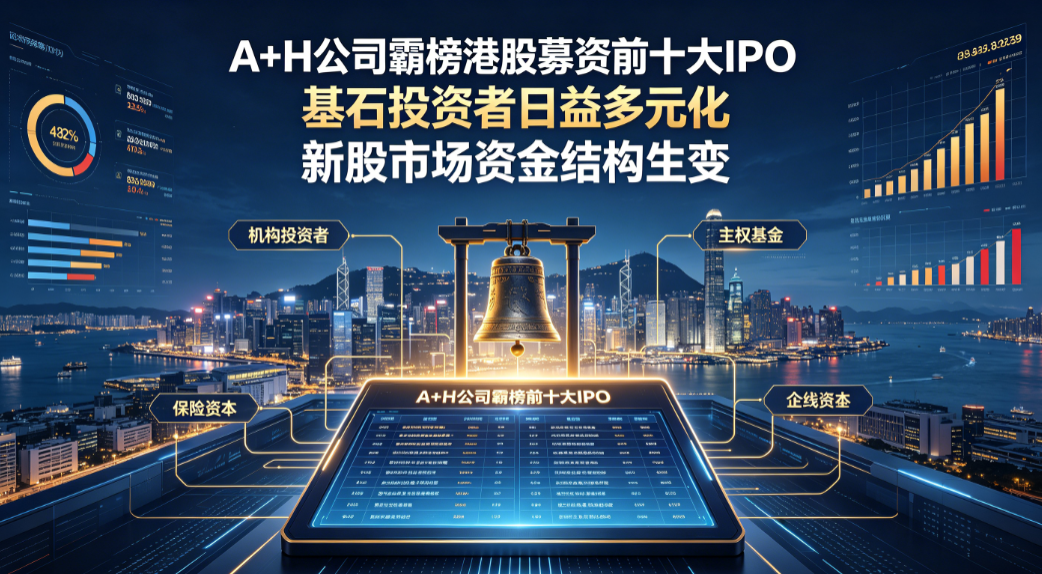
This year, the pace of mainland Chinese companies seeking Hong Kong listings has accelerated sharply. According to Wind, 24 A-share listed companies successfully issued H shares in the first half of 2026, raising a combined HKD 121.733 billion, setting a new record for the same period in history. Even more striking, A+H companies occupied 8 of the top 10 IPO fundraising positions in Hong Kong, underscoring the strong cross-border financing power of China’s industry leaders.
The trend is not simply about fundraising. It reflects a deeper shift in how China’s best companies are positioning themselves for global capital access, valuation discovery, and long-term strategic flexibility. For Hong Kong, it has also become a powerful reaffirmation of its role as the preferred offshore capital hub for high-quality Chinese assets.
The A+H Wave Continues to Expand
Although several companies were still listed in Hong Kong on June 29 and 30, none were secondary listings of A-share companies. As a result, the June 26 triple listing effectively marked the stage-ending moment for the first-half A+H boom.
The market reaction to the three debutants was notably differentiated. Chipone Technology surged 103.77% on its first trading day, becoming the standout performer. SG Micro Corp rose 47.04%, while Luxshare Precision closed 4.62% lower.
Despite the mixed immediate performance, the trio shares a common identity: all are leaders in strategically important, technology-driven niches.
- Chipone Technology specializes in micro-nano direct imaging lithography. Based on 2025 revenue, it is the world’s largest supplier of direct imaging equipment for PCB manufacturing, with a market share of 18.8%. As a rare domestic player in high-end PCB direct imaging equipment, it has helped break overseas monopoly in this segment. Its Hong Kong offering raised approximately HKD 3.245 billion.
- SG Micro Corp is a leading domestic high-performance analog integrated circuit company. Its products are widely used in consumer electronics, industrial control, and other applications. It raised HKD 4.601 billion in its Hong Kong debut.
- Luxshare Precision is a global leader in intelligent manufacturing for AI terminal devices. Based on 2025 revenue, it ranked first globally in the market for high-precision functional components used in AI terminal equipment. Its H-share fundraising amounted to HKD 8.264 billion.
These companies are not merely raising capital; they are collectively representing the capital market appeal of China’s advanced manufacturing and hard-tech sector.
Why Top Chinese Companies Are Heading to Hong Kong
The surge in A+H listings is not a short-lived financing fad. It is the result of multiple structural factors converging.
1. Hong Kong Offers Efficient International Capital Access
For leading A-share companies, Hong Kong remains one of the most efficient platforms for international financing. It provides access to a broader investor base, including global long-only funds, sovereign wealth funds, and long-term institutional investors that may be difficult to tap purely through the domestic market.
The Hong Kong market also supports flexible fund-raising structures and offers companies a relatively mature legal, regulatory, and disclosure framework. For high-quality issuers, this means not just capital, but also global visibility and an additional pricing mechanism.
2. Dual Listing Strengthens Strategic Resilience
In a more uncertain global macro environment, a dual-listed structure can enhance corporate resilience. It expands financing channels, improves liquidity, and strengthens a company’s ability to respond to future investment, overseas expansion, and M&A opportunities.
For technology and manufacturing leaders with long R&D cycles and capital-intensive expansion plans, the Hong Kong market is especially attractive because it allows them to finance growth without relying solely on domestic market cycles.
3. Hard-Tech Leaders Are Better Suited to Cross-Border Pricing
The first-half A+H wave was dominated by technology, industrial, consumer, and healthcare companies. This pattern suggests that Hong Kong investors are increasingly willing to reward companies with strong industrial barriers, global competitiveness, and clear earnings visibility.
These sectors are particularly appealing because they combine China’s manufacturing depth with global market relevance. Investors are not just buying growth — they are buying technological capability, supply-chain position, and long-term earnings durability.
Record Fundraising Reflects Quality Concentration
The scale of first-half fundraising is itself a signal. A total of 24 A-share companies issuing H shares and raising over HKD 121.7 billion is evidence that Hong Kong’s equity market is attracting the most credible issuers, not just the most urgent ones.
Within the broader Hong Kong IPO market, A+H companies were especially dominant. In the top 10 IPO fundraising list for the first half, 8 were A+H names. Victory Giant Technology led the pack with HKD 23.135 billion, followed by Muyuan Foods with HKD 12.099 billion and Tingyi-related consumer peer? No — Dongpeng Beverage with HKD 11.099 billion. Other A+H names such as JCET Group, Luxshare Precision, Dajin Heavy Industry, Dazu Laser, and Gigadevice also entered the top tier, each raising more than HKD 5 billion.
This concentration matters because it shows that the IPO market is becoming more selective. The most profitable and strategically important Chinese companies are no longer dependent on a single market for capital. Instead, they are able to choose among venues and extract pricing power from strong investor demand.
Cornerstone Investors: A More Global and Diversified Base
Another notable feature of the 2026 A+H wave is the rise of cornerstone participation.
According to market data, 85% of Hong Kong IPOs in the first half introduced cornerstone investors, and the investor base became more diverse. Domestic top-tier public funds, insurance asset managers, brokerages, and government-guided industrial funds formed the core allocation group. At the same time, participation from Middle Eastern sovereign funds, Southeast Asian long-term capital, and European and U.S. asset managers increased steadily.
The three listings on June 26 illustrated this trend clearly:
- Chipone Technology attracted cornerstone investors including Hillhouse, Greenwoods, local government capital from Hefei, and supply-chain partners from the semiconductor ecosystem.
- SG Micro Corp brought in institutions such as GIC, Hillhouse, and Morgan Asset Management.
- Luxshare Precision also secured a broad mix of domestic and overseas long-term capital.
This broadening investor structure is highly meaningful. It suggests that Hong Kong IPOs are no longer relying only on regional capital or speculative demand. Instead, they are increasingly anchored by patient capital with deeper industry understanding and longer holding horizons.
As Ernst & Young Hong Kong’s technology, media and telecom audit lead Chen Rihui noted, cornerstone investors in the first half included sovereign funds from the Middle East and Singapore. He pointed out that international investors, including sovereign wealth funds and leading asset managers, have been active supporters of IPOs this year. Their participation reflects growing confidence in China’s hard assets, a more constructive view of the regulatory backdrop, and stronger belief in long-term investment opportunities.
Strong First-Day Returns, But Valuation Logic Varies
From a trading perspective, the first-half A+H cohort delivered solid overall performance. Of the 24 new A+H listings, 19 closed higher on their first day, accounting for nearly 80%.
The strongest gains were concentrated in hard-tech names:
- Chipone Technology: +103.77%
- Lanshi Technology (JCET-like peer in memory sector?): +63.72%
- Victory Giant Technology: +50.09%
- GigaDevice: +37.53%
- Guanghe Technology and Sunwoda / Star material-related peers also recorded first-day gains above 20%
By contrast, consumer names such as Muyuan Foods and Dongpeng Beverage posted modest first-day increases of less than 4%, while a few stocks weakened due to sector cycle pressure and market sentiment.
Looking at the cumulative performance since listing, some names have performed exceptionally well. As of June 26, GigaDevice traded 569.79% above its issue price, while Lanshi Technology, Dazu Laser, Guanghe Technology, and Guoen Technology had more than doubled.
This divergence highlights an important market truth: investors are currently rewarding technological scarcity, domestic substitution potential, and global competitiveness far more than traditional scale alone.
AH Premium Remains High, Reflecting Different Investor Preferences
As the A+H wave intensified, the AH premium index became another closely watched market indicator. On June 26, the Hang Seng AH Premium Index stood at 122.43. It had earlier fallen to 113.56 before rising to a high of 124.54, then fluctuating around the 118 level.
Among the newly listed names, Chipone Technology had an AH premium of 32.45%, while SG Micro Corp was only 17.92%, relatively low by historical standards. Some A+H names such as GigaDevice, Lanshi Technology, and Dajin Heavy Industry are currently trading at a discount in Hong Kong versus A-shares, while others such as National Tech, Maxscend, and Eascend show AH premiums exceeding 100%.
Why does this happen? In essence, the AH premium is not just about market inefficiency. It reflects different investor bases, liquidity structures, and valuation preferences. Stocks with stable cash flow, cyclical recovery potential, or defensive characteristics often have lower AH premiums. By contrast, companies with clear global competitiveness, high return on equity, and strong governance transparency can attract foreign investors willing to pay a premium in Hong Kong.
In the view of Great Wall Securities, sectors such as non-ferrous metals, banks, food and beverage, coal, and transportation tend to have relatively low AH premiums because Hong Kong investors may be more willing to assign higher valuations to companies with visible cash flow or cyclical upside. Meanwhile, the fact that companies such as CATL, China Merchants Bank, WuXi AppTec, GigaDevice, and Longshine have seen Hong Kong prices exceed A-share prices reflects global long-term capital’s “certainty preference” for leading Chinese assets.
This also implies that the pricing power of mainland investors is not always dominant when a company has strong international appeal. In such cases, foreign capital can materially influence H-share valuation, particularly when the issuer is perceived as globally scalable and governance-transparent.
Conclusion
The first half of 2026 has marked a decisive new phase in the evolution of A+H listings. The simultaneous Hong Kong debut of Luxshare Precision, SG Micro Corp, and Chipone Technology did not merely close out a fundraising cycle; it showcased the rising confidence of China’s best companies in using Hong Kong as a global capital platform.
The numbers speak for themselves: 24 successful A-share to H-share listings, over HKD 121.7 billion raised, and 8 A+H names in the Hong Kong IPO top 10. Behind these figures lies a broader shift toward cross-border capital mobility, industrial upgrading, and valuation internationalization.
More importantly, the market is sending a clear message. Companies with hard-tech capabilities, strong industry positions, and long-term growth visibility are commanding the greatest investor attention. At the same time, the growing diversity of cornerstone investors shows that confidence in China’s core assets remains resilient among domestic and global institutions alike.
Looking ahead, the A+H listing wave is unlikely to slow down quickly. As more leading Chinese enterprises seek to optimize financing structures and broaden their global footprint, Hong Kong’s role as a bridge between China’s industrial champions and international capital is set to become even more important.